How to trim your cat’s nails at home?
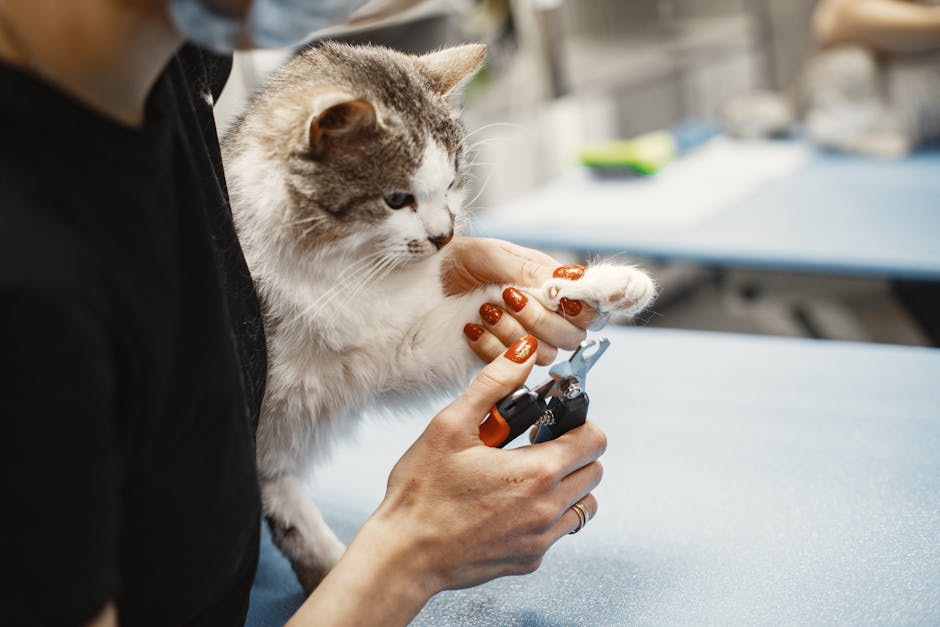
The claws of a cat grow and are constantly updated throughout life, and the animal can adjust their length on its own, grinding on hard objects. This procedure is mandatory for cats, because too long claws interfere with walking, exfoliate and can painfully grow into the skin. If the owners let the pet out for a walk, the problem is solved by itself: the animal adjusts the length by grinding its claws on trees or asphalt. Domestic cats in this case scratch bedside tables, sofas, walls, door jambs. To save the furniture and interior, as well as take care of the health of the pet, it is recommended to trim the claws on time. In order for the procedure to be as quick and painless as possible, you need to choose the right tools and prepare the animal for a haircut.
When should nails be trimmed?
Before proceeding with the hygiene procedure, you need to weigh the pros and cons. The fact is that cutting in any case gives the pet pain, because there are nerve endings in the claw. Having carried out the procedure once, it will need to be repeated regularly throughout the life of the animal. If the pet is obedient, sharpens its claws only on the nail cutter and does not scratch other objects, then you should seriously think about whether such a procedure is needed in principle.
Another indirect argument “against” is the violation of the nervous system of the animal. The claws of a cat are the main tool of life: with their help, the animal obtains food, climbs trees, defends itself in the fight. Due to the impossibility of carrying out the usual actions, the cat’s psyche is disturbed. In addition, trying to climb a tree or a tall object out of habit, he can be injured. For this reason, pet owners who are allowed to walk outside are advised to refrain from such a hygiene procedure.
It is necessary to trim the nails in 2 cases: before the show and before mating. Otherwise, it all depends on the desire of the owner. If the animal is aggressive, often scratches, and there are small children in the house, a haircut will be the right way out of the situation and protect the household from injury. It is possible that after such a procedure, the pet will become more docile.
Tool selection
Before you cut your cat’s nails, you need to arm yourself with the right tools. It is desirable that these were not ordinary scissors, but a special cat “manicure” set. Such accessories are called nail clippers and can be purchased at any pet store. Each of them is a suitable tool for the procedure, so you can buy any you like. Preference should be given to products made of stainless steel, with sharp blades and rubberized handles for maximum safety of use.
If possible, you can take several varieties at once and in the future use the one that you liked the most. Detailed characteristics of nail cutters will help you make the right choice:
| Type of nail clipper | Characteristic |
| Scissors
|
The tool is recommended for beginners, as they are the easiest to use. Outwardly, the device resembles scissors with holes for the fingers, but at the end of the blade there is a rounded cutout. It is here that the part of the claw that needs to be cut is laid. |
| Forceps
|
The tool is similar to ordinary pliers, only with rubberized handles for easy fixation. It is equipped with a blade lock function, which is very convenient if there are small children in the house. The device can be activated only by moving the lever at the base. More expensive models have a special limiter that allows you to cut only the required length. |
| Guillotine
|
Named by analogy with a medieval device. It has a curved shape and rubberized inserts on the handles so that the device does not slip out of your hands during the procedure. When you press the handle, a sharp blade appears, which quickly and efficiently cuts off the claw. The only negative is the inability to see the length of the section to be cut, so the tool is recommended for experienced cat owners. |
| Electric nail clipper
|
The principle of operation is to grind the claw with a rapidly rotating wheel with a special nozzle. Such a device is often used in grooming salons, since it not only cuts, but also corrects the edges of the claw. The tool is not recommended for beginners to avoid injury to the pet. |
If you don’t have the right tool at home, you can use ordinary scissors with sharp blades or nail clippers, having previously treated the item with alcohol. Professional devices also need mandatory disinfection. It is impossible to neglect the recommendation so as not to harm the health of the pet.
It is strongly not recommended to use nail scissors for trimming nails, as they are not designed for such a dense nail plate. Cutting the claw with such a device will not work: it will only damage the plate, which will lead to delamination and cause pain to the pet.
How to trim your nails at home
It is recommended to trim the nails once every 1-2 months, depending on the growth rate of the nail plate. Light claws grow faster than dark ones, so the procedure will have to be carried out more often. An active pet can shorten the length on its own, but lazy homebodies will have to help with this. It is not worth trimming the claws too often, since it is possible to affect not the keratinized areas, but the nerve endings.
It is advisable to accustom a pet to cutting its claws as a kitten. So he will get used to a regular hygiene procedure, will not experience fear and inconvenience, and in adulthood there will be no problems with him. So that the animal is not afraid, before the haircut, you need to stroke and gently massage the paws, press the pads so that the kitten shows its claws.
Preparatory stage
It is very important to seize the right moment for the procedure at home. You can cut the claws if the pet:
- full;
- calm;
- is at rest or half asleep.
These are necessary conditions so that further manipulations do not cause stress in the animal. Only a favorable friendly atmosphere will help a cat, especially an adult, easily and painlessly survive unpleasant moments. If she breaks out and is aggressive, it is better to postpone the procedure for a while. The use of force will not lead to anything good: during resistance, there is a high risk of cutting off more than necessary, or accidentally dislocating the pet’s paw.
Nail clipping should not be done when the animal is playing, in an active waking state, or if it is hungry or sick.
If the owner does not have experience in carrying out such a procedure, it is recommended to call a friend or someone from the household for help. One person will hold the pet and the other will handle the claws. Before work, it is imperative to treat the tools with an alcohol solution to avoid possible infection.
Nail clipping
Haircut is recommended to be carried out in the daytime, so that the claws can be seen. During the procedure, you should have at hand:
- disinfected cat “manicure” set, consisting of scissors (claw cutters) and nail files;
- antiseptic (hydrogen peroxide or iodine);
- baby talc;
- cotton pad.
Before the procedure, the owners of long-haired cats should cut the tufts of hair between the claws. Otherwise, it will be very problematic to determine the desired length of the cut section. It is better to do this with a hair clipper, but if the animal is afraid of noise or the owner does not have the skills to handle the device, you can use sharp scissors.
Step-by-step instruction:
- 1. Take the animal in your arms, comfortably seat it on your knees or take it under your paws, pressing the body to your stomach. You need to handle the pet gently and at the same time confidently in order to firmly fix its position. This will help to avoid injury during the procedure if the cat starts to break out.
- 2. Gently stroke the animal, gradually moving to the pads on the paws (at this time it is advisable to talk to the cat so that he does not suspect anything). Gently press down on the pad until the claws show.
- 3. Carefully examine the claws in the light from the inside and determine the place where the blood vessels begin. On the transparent nail plate, red stripes are clearly visible, which cannot be touched.
- 4. Place scissors or nail cutter perpendicular to the nail and cut off the free edge, leaving 1-2 mm to the blood vessels. It is advisable to cut off the desired piece the first time so that the plate does not exfoliate. In the same way, process the claws on the front and hind limbs. If during the procedure the animal began to break out, it can be wrapped in a towel and the paws are released one by one.
- 5. Grind the edges of the claws with a nail file or an emery bar so that later they do not cling to the carpet or furniture and do not cause discomfort to the pet when walking.
- 6. After polishing, treat the nails with hydrogen peroxide to avoid infection.
At the end of the procedure, it is recommended to reward the cat with your favorite treat, praise for good behavior and caress to bring the pet out of a stressful state.
First aid for injuries
In case of accidental damage to the blood vessels, the bleeding must be stopped immediately and infection prevented. You need to pull yourself together, act quickly, clearly and confidently. The claw must be treated with an antiseptic using a cotton swab, and then sprinkled with baby talc. If the next day there is caked blood, you need to repeat the same manipulations.
After an injury, a pet may limp for several days. He should not be allowed outside until the wound heals. It is desirable that during this period he moves less.
Injury to a pet is an exception to the rule and is allowed only during the first treatment. If the situation repeats itself for the second or third time, you should take care of the cat’s mental and physical health and seek help from specialists.
Trimming a cat’s nails is not difficult if you follow these recommendations clearly. Each time, the procedure will take place more quickly and efficiently, because with experience dexterity will come and skills will appear. In the future, it is recommended to come up with a “manicure day” and cut the nails at the same time.


